
Cyber Leek GTA 6: Deep Dive into Gameplay, Map & Next-Gen Engine Tech
 By Nadeem
0 Comments
By Nadeem
0 Comments
Few upcoming releases in interactive entertainment history command the sheer cultural weight and technical anticipation of Grand Theft Auto VI. At Cyber Leek, our goal is to cut through the noise and provide an authentic, research-driven look at how this title is poised to redefine open-world engineering. From the reimagined neon sprawl of Vice City to the cutting-edge physics simulations under the hood of the RAGE engine, here is our comprehensive breakdown of what makes GTA 6 the most ambitious sandbox ever conceived.
1. Setting the Stage: The New Benchmark for Open-World Design
When Grand Theft Auto V debuted over a decade ago, it established a gold standard for dynamic urban environments on hardware that is now considered vintage. In the intervening years, gaming technology underwent a generational transformation: high-speed solid-state storage (NVMe SSDs), dedicated hardware-accelerated ray tracing cores, multi-threaded processor architectures, and sophisticated machine-learning upscalers have changed the playing field.
Grand Theft Auto VI is built from the ground up to exploit this modern hardware architecture. Rather than treating an open world as a static painted backdrop populated by scripted events, Rockstar Games is constructing a truly systemic environment where physics, weather, social interactions, and economy influence each other in real time. For our team here at Cyber Leek, observing this evolution isn’t just about looking at trailers; it is about examining the patented software engineering behind dynamic NPC memory, fluid dynamics, and volumetric atmosphere.
2. The State of Leonida: Reimagining Vice City on a Continental Scale
The setting of GTA 6 brings players back to the beloved sun-soaked streets of Vice City, but this is far from a simple nostalgia trip. The playable world encompasses the entire fictional state of Leonida—a sprawling, diverse geographic region inspired by Florida and the American Southeast.
What makes Leonida fundamentally different from previous game maps is its biome variety and architectural scale:
- The Vice City Metro Core: Characterized by gleaming coastal high-rises, Ocean Drive art-deco hotels, upscale shopping promenades, and vibrant beach strips. The urban density features multi-tiered road networks, functional underground parking structures, and fully accessible public spaces.
- The Grassrivers (Everglades Analogue): A vast, treacherous wetland ecosystem governed by muddy marshes, sawgrass canals, airboat waterways, and indigenous wildlife such as alligators and wading birds. The terrain physics here demand specialized vehicles and careful navigation.
- The Keys and Archipelago Chains: Long, sun-drenched oceanic highway causeways connecting remote tropical islands, boat harbors, and coastal fishing outposts, creating exceptional opportunities for long-distance maritime exploration.
- Industrial Ports and Rural Outskirts: Sunken container ports, manufacturing plants, sprawling suburban strip malls, and forgotten backwoods communities that contrast sharply with the luxury of downtown Vice City.
Initial mapping analyses conducted by gaming cartographers suggest that Leonida is not just larger in sheer square mileage than GTA V’s Los Santos, but significantly denser in terms of enterable buildings, interior detail, and verticality.
3. Under the Hood: Inside the RAGE 9 Engine Innovations
At the technological heart of GTA 6 lies the newest iteration of the proprietary Rockstar Advanced Game Engine (RAGE). The engineering updates introduced in this engine version represent a generational leap over the technology that powered Red Dead Redemption 2.
A. Real-Time Water Simulation and Hydrodynamics
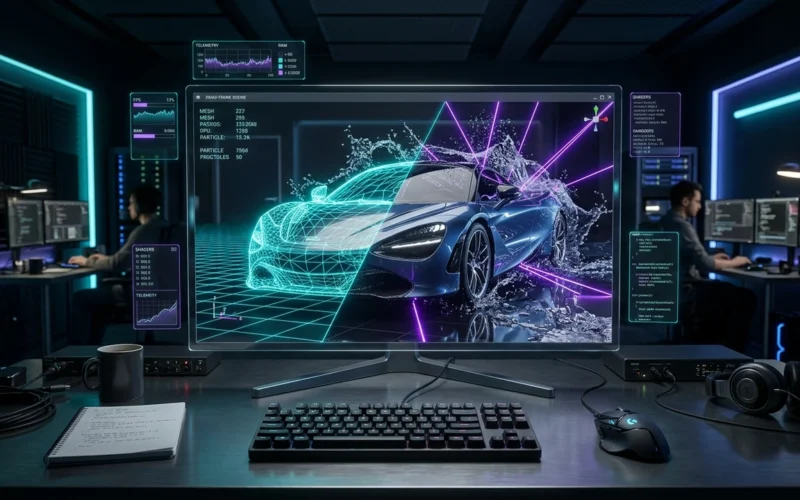
Water has always been one of the most computationally expensive elements to simulate realistically in interactive media. In Leonida, water is not simply a decorative flat plane with repeating wave textures; it is a full physical medium. The engine incorporates real-time buoyancy calculations, dynamic wave propagation based on wind speed and boat wake, and variable coastal turbidity. Whether you are navigating a speedboat through high-tide waves or observing tropical rain pooling on asphalt, the fluid behavior mirrors real-world physics.
B. Volumetric Clouds and Meteorological Weather Systems
Weather in Leonida is an organic, evolving force rather than an arbitrary skybox swap. True volumetric cloud rendering allows clouds to form, gather moisture, cast accurate shadows across the terrain, and generate localized thunderstorms. You can witness a tropical squall dumping heavy rain over the beaches while the sun continues to bake the western wetlands. Lightning illuminates cloud volumes internally, producing astonishingly realistic twilight atmospheres.
C. Physically Based Lighting and Hardware Ray Tracing
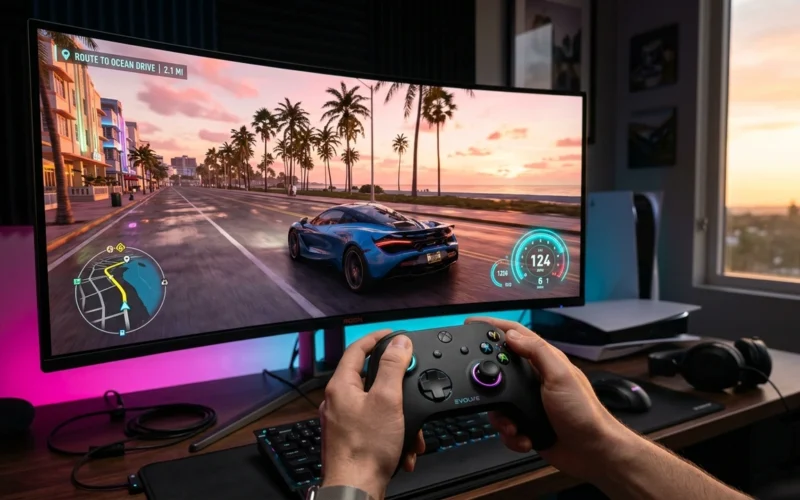
By leveraging dedicated RT cores on PlayStation 5 and Xbox Series X, the engine achieves photorealistic global illumination. Light bounces naturally off neon signs, wet pavements, car enamel, and polished interior tiles. Nighttime in Vice City becomes an explosion of vibrant color and realistic reflections that transform the city into a living visual spectacle.
4. Living Ecosystem: Advanced NPC Artificial Intelligence
One of the most persistent illusions in modern open-world gaming is the non-playable character (NPC). Traditionally, NPCs follow basic looped patrol paths and react with canned animations when disrupted. In GTA 6, patent disclosures and gameplay reveals indicate a seismic shift toward intelligent behavioral modeling.
The citizens of Leonida possess distinct personality archetypes, daily work-life routines, and environmental awareness:
- Contextual Spatial Awareness: NPCs react realistically to weather changes (seeking shelter under awnings during sudden downpours), traffic flow, pedestrian density, and player behavior without resorting to chaotic hive-mind panic.
- Social Media Integration: Reflecting modern youth and internet culture, pedestrians frequently film chaotic street encounters, livestream events on in-game social media feeds, and capture spontaneous happenings around the city.
- Persistent Memory and Dynamic Reactions: Encounters can escalate or de-escalate dynamically based on how the player approaches a situation—whether through body language, vehicle speed, or verbal engagement.
5. Dual Protagonists: The Interplay Between Lucia and Jason
Narrative structure in GTA 6 centers around two dynamic, interconnected protagonists: Lucia and Jason. Unlike the three-character mechanic of GTA V which often separated the cast across opposite ends of the county, Lucia and Jason’s relationship forms the emotional and tactical backbone of the storyline.
Drawing thematic inspiration from modern crime dramas and classic outlaw duos, their dynamic introduces innovative cooperative mechanics:
- Synchronized Tactical Maneuvering: Players can coordinate entries into restricted areas, manage shared inventory space, and alternate roles between getaway driver and lookout.
- Shared Economy and Resources: Managing resources, vehicle trunks for gear storage, and safehouses requires strategic planning as the pair navigates the criminal underworld of Leonida.
- Emotional Depth and Narrative Agency: The dialogue between Lucia and Jason develops organically based on shared experiences, creating a richer, more character-driven storyline that grounds the chaotic sandbox action in human stakes.
6. Vehicle Dynamics and Next-Gen Handling Physics
Vehicles are the lifeblood of the Grand Theft Auto franchise, and GTA 6 elevates vehicle physics to unprecedented levels of sophistication. Driving in Leonida strikes an intentional balance between arcade accessibility and realistic vehicular weight distribution.
Key vehicular enhancements include:
- Detailed Deformation and Damage Models: Crumple zones, glass shattering patterns, and paint scratches reflect the exact angle and velocity of impacts rather than relying on pre-baked deformation meshes.
- Tire Grip and Surface Friction: Transitioning from dry sun-baked highways to rain-slicked tarmac, swamp mud, or sandy beaches requires genuine throttle control and adaptation.
- Cabin Interactivity and Customization: Interior car dashboards feature functional gauges, working navigation screens, adjustable mirrors, and realistic pedal animations, providing an immersive first-person driving perspective.
7. 3D Spatial Soundscapes and Environmental Acoustics
While visual presentation often captures the spotlight, acoustic design is what truly cements presence in a virtual world. GTA 6 leverages modern 3D spatial audio architectures to recreate the sonic fingerprint of a subtropical metropolis.
Sound travels with realistic reverberation and occlusion: the distant bass thumping from a beachside nightclub muffled behind double-glazed glass, the echoing siren bouncing between high-rise corridors, and the tranquil hum of cicadas in the midnight wetlands all contribute to an acoustic tapestry that feels astonishingly authentic.
8. Platform Launch Strategy: Consoles First, PC Evolution
In keeping with historical release patterns, Grand Theft Auto VI is slated for an initial launch on current-generation consoles: PlayStation 5 and Xbox Series X|S. This laser focus allows developers to optimize directly for fixed hardware baselines without the performance compromises that multi-generation cross-gen releases often necessitate.
For PC enthusiasts, the anticipated subsequent release promises to unlock unlocked frame rates, ultrawide display configurations, and advanced ray-tracing parameters that will serve as a premier benchmarking showcase for modern graphics hardware for years to come.
9. Frequently Asked Questions (FAQ)
What is Cyber Leek’s focus regarding GTA 6?
Cyber Leek is an independent analytical publication dedicated to in-depth technical breakdowns, verified news tracking, world design analysis, and player guides for GTA 6. We focus on ethical, policy-compliant journalism that celebrates the engineering achievements of modern gaming.
Where does GTA 6 take place?
GTA 6 is set in the fictional state of Leonida, which includes a massively expanded, modernized reimagining of Vice City alongside diverse surrounding wetlands, island keys, and rural communities.
Who are the main playable characters?
The narrative revolves around dual protagonists, Lucia and Jason, exploring a dynamic criminal partnership influenced by classic outlaw narratives and contemporary open-world storytelling.
10. Conclusion: A Transformative Leap for Digital Worlds
Grand Theft Auto VI is not simply another sequel; it represents a generational milestone for interactive entertainment. By combining unprecedented geographical density with bleeding-edge RAGE 9 engine physics, authentic artificial intelligence, and a compelling dual-character narrative, the team at Rockstar Games is once again poised to redefine what players expect from virtual worlds.
Here at Cyber Leek, we will continue to provide our readers with comprehensive technical guides, verified news updates, and expert analysis as we journey closer to launch. Stay tuned, explore our latest guides, and join us in breaking down the future of gaming.