Vice City in GTA 6: Architecture, Districts & World Evolution
 By Nadeem
0 Comments
By Nadeem
0 Comments
Few fictional settings in digital entertainment command the immediate affection, atmospheric swagger, and cultural legacy of Vice City. First immortalized through the sun-bleached, pastel-hued lens of the 1980s, this iconic metropolis has returned—rebuilt from the ground up for a new generation of open-world gaming in Grand Theft Auto VI. At Cyber Leek, we take a deep, analytical look at the architectural triumphs, regional districts, and technological evolutions that make modern Vice City the most ambitious urban playground ever designed.
1. The Legend Returns: Why Vice City Remains Iconic
When gamers first set foot in Vice City in 2002, the gaming landscape changed forever. It wasn’t merely the infectious synthwave soundtrack or the Hawaiian shirts; it was the realization that a virtual city could possess a distinct soul, a palpable mood, and a vibrant cultural pulse. For more than two decades, the prospect of returning to Vice City has topped the wishlist of open-world enthusiasts worldwide.
However, bringing Vice City into the contemporary era requires far more than modernizing nostalgic tropes. The modern incarnation is not an ’80s period piece; it is a sprawling, razor-sharp satire of modern coastal society in the 2020s. Influenced by the explosive growth, cultural diversity, social media culture, and glamorous excess of contemporary Miami and South Florida, the new Vice City reflects a metropolis that is glamorous, chaotic, and technologically breathtaking.
2. The Chronological Evolution: 1986 vs. The Modern Era
To truly appreciate the architectural leap represented in Grand Theft Auto VI, one must examine the profound technological contrast between the original PS2-era rendition and today’s next-generation platform capabilities:
- Scale and Geometry: The original 2002 map was a triumph for its time, yet comprised modest polygon counts, repetitive building facades, and static skyboxes. Today’s Vice City features fully modeled architectural structures with millimeter-precise bevels, custom window reflections, rooftop air conditioning infrastructure, and intricate interior floorplans.
- Atmospheric Volumetrics: Rather than relying on simple distance fog to mask hardware rendering limits, the new game engine simulates atmospheric humidity. The coastal air feels dense with moisture; sunlight scatters organically through tropical haze during the golden hour, casting dynamic shadows through swaying palm canopies.
- Living Density: The original streets were sparsely populated due to memory limitations. In modern Vice City, sidewalks thrum with diverse crowds—beachgoers rollerblading down boardwalks, fitness enthusiasts jogging with earbuds, tourists capturing selfies, and street performers drawing spontaneous audiences.
3. Navigating the Districts: A Detailed Urban Breakdown
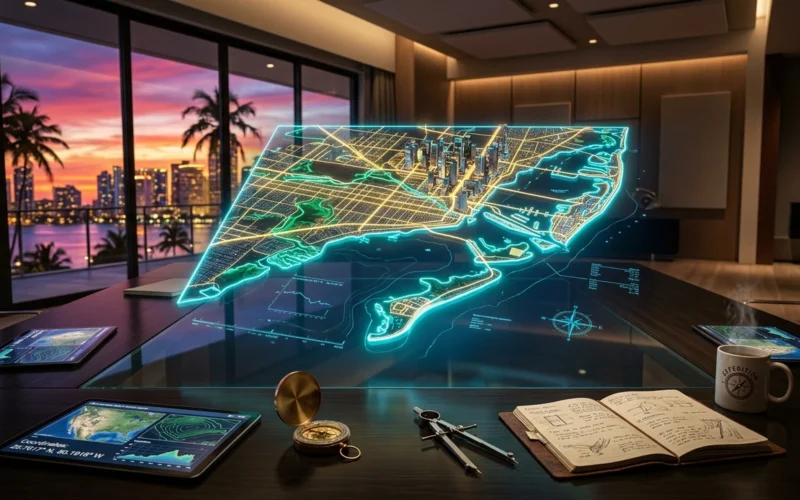
The state of Leonida surrounds a metropolitan core divided into several unique, culturally authentic districts. Each borough boasts its own distinct architectural language, economic profile, and social ecosystem:
A. Ocean Beach and the Art Deco Strip
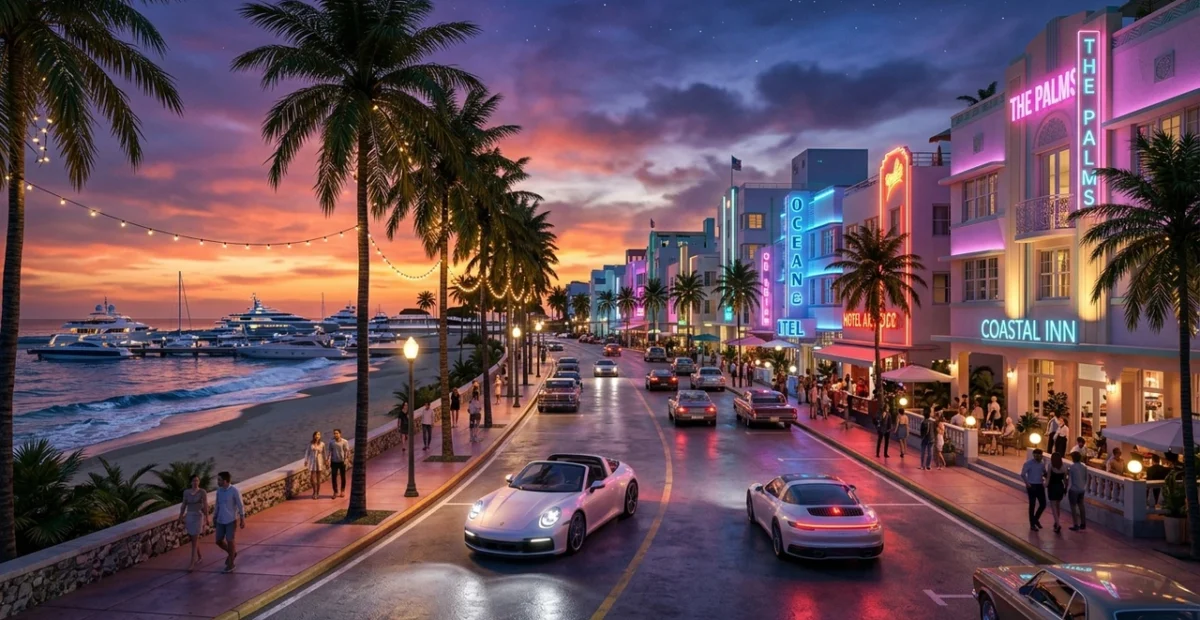
The crown jewel of Vice City’s coastal tourism, Ocean Beach is defined by its pristine shoreline, wide pedestrian esplanades, and historic Art Deco hotel facades. By day, pastel pinks, baby blues, and seafoam greens dominate the skyline under clear subtropical skies. By night, these historic buildings ignite with thousands of linear neon tubes, casting luminous reflections onto glistening roads and parked luxury convertibles.
B. Downtown Vice City: The Corporate Financial Corridor
In sharp contrast to the beachfront leisure zones, Downtown Vice City represents the economic engine of Leonida. Towering skyscrapers constructed from reflective structural glass and polished steel scrape the clouds. Multi-tiered freeway overpasses weave through skyscraper canyons, creating complex vertical driving routes. Below, corporate plazas, banking headquarters, transit stations, and underground parking complexes offer extensive opportunities for grounded exploration.
C. Cultural Enclaves: Little Haiti and Little Havana
Real-world South Florida owes its vibrant identity to its rich Caribbean and Latin American heritage, and Vice City faithfully mirrors this cultural mosaic. Neighborhoods inspired by Little Haiti and Little Havana feature single-story residential bungalows, vibrant hand-painted murals, family-run botanical shops, lively outdoor cafes, and open-air domino parks. The auditory atmosphere shifts noticeably here, filled with regional music, street vendors, and animated bilingual conversations.
D. Starfish Island and Luxury Gated Communities
Nestled along the sheltered waterways between the mainland and the barrier beaches lie the luxury residential islands. Reminiscent of Starfish Island from the classic era, these secluded enclaves host opulent Mediterranean-style mansions, gated compound estates, tennis courts, infinity pools, and private deep-water docks accommodating high-end speedboats and mega-yachts.
E. Vice City International Airport (VIA) and Shipping Ports
Infrastructure is vital for establishing world realism. Vice City International is an expansive, functional aviation hub complete with active passenger terminals, luggage transit networks, perimeter radar towers, and expansive parallel runways. Nearby, the industrial shipping port features towering gantry cranes, labyrinthine container yards, and heavy freight logistics, providing a stark industrial contrast to the tourist districts.
4. Architectural Realism: How Modern Engine Tech Powers the City
The visual splendor of Vice City is not merely the result of talented 3D modeling; it is propelled by groundbreaking graphics innovations within the proprietary Rockstar Advanced Game Engine (RAGE):
A. Hardware-Accelerated Ray Tracing and Global Illumination
Traditional video game lighting relied on pre-calculated lightmaps, which meant that dynamic light sources couldn’t naturally interact with moving objects. In modern Vice City, hardware ray tracing calculates millions of real-time light bounces. When a neon pink sign flickers outside an Ocean Drive cocktail bar, its warm glow dynamically illuminates passersby, reflects accurately on curved automotive chrome, and bounces off nearby stucco walls.
B. Seamless Interior-to-Exterior Transitions
One of the most transformative leaps in modern open-world design is the elimination of loading screens when stepping indoors. A significant percentage of storefronts, restaurants, gas stations, luxury penthouses, and nightlife venues in Vice City feature seamless enterable interiors. You can walk smoothly from a bustling sunny street into a quiet air-conditioned convenience store, peering through the glass windows as street traffic continues to pass uninterrupted outside.
C. Micro-Weather and Surface Moisture Physics
Vice City’s climate is notoriously volatile. When sudden subtropical thunderstorms sweep across the bay, rain doesn’t fall as a uniform screen effect; it pools dynamically in road depressions, creates localized hydroplaning risks for vehicles, and dampens building materials with realistic specular sheen. As the sun breaks through parting clouds, wet surfaces evaporate gradually based on ambient temperature and wind speed.
5. Maritime Culture: The Ocean as an Active Playground
In many open-world titles, large bodies of water serve as passive boundaries that separate landmasses. In Vice City, the ocean is an integral gameplay domain. The surrounding waterways—from protected bay canals to the open Atlantic ocean—are governed by complex hydrodynamic wave simulation.
Players can navigate high-performance jet skis across choppy coastal swells, pilot luxury offshore speedboats through the Keys causeways, or explore vibrant marine life around barrier reef systems. Water reacts physically to hull shapes, creating authentic wake displacement and requiring genuine throttle modulation during turbulent weather.
6. Frequently Asked Questions (FAQ) About Vice City
Is Vice City in GTA 6 the exact same map as the 2002 game?
No. While it honors beloved landmarks, districts, and the iconic coastal layout of the classic map, the modern Vice City is a vastly expanded, contemporary reimagining set within the broader state of Leonida. It is many times larger, features multiple new surrounding biomes, and is modeled after modern 2020s South Florida.
Can players explore areas outside of the Vice City urban core?
Yes. Vice City is just one metropolitan region within the state of Leonida. Players can seamlessly travel beyond city limits into the vast Grassrivers wetlands (Everglades), rural agricultural settlements, and the extensive southern island chains connected by oceanic causeways.
How does the neon lighting look during the night cycle?
Thanks to full ray-traced global illumination and volumetric fog, nighttime in Vice City is breathtaking. Neon signs cast authentic, vibrant colors across sidewalks, wet pavements, and vehicle surfaces, creating a cinematic visual spectacle unmatched in interactive gaming.
7. Conclusion: The Ultimate Sandbox Metropolis
Vice City is more than a collection of digital roads and buildings; it is a cultural monument in the history of video games. By merging the beloved aesthetic DNA of its past with unprecedented next-generation engine technology, architectural authenticity, and living NPC ecosystems, Grand Theft Auto VI is set to deliver an urban experience that will define open-world gaming for years to come.
Stay tuned to Cyber Leek as we continue to track, analyze, and break down every street corner, patent disclosure, and developmental milestone shaping this historic virtual world.