
RAGE 9 Engine: The Groundbreaking Technology Powering GTA 6
 By Nadeem
0 Comments
By Nadeem
0 Comments
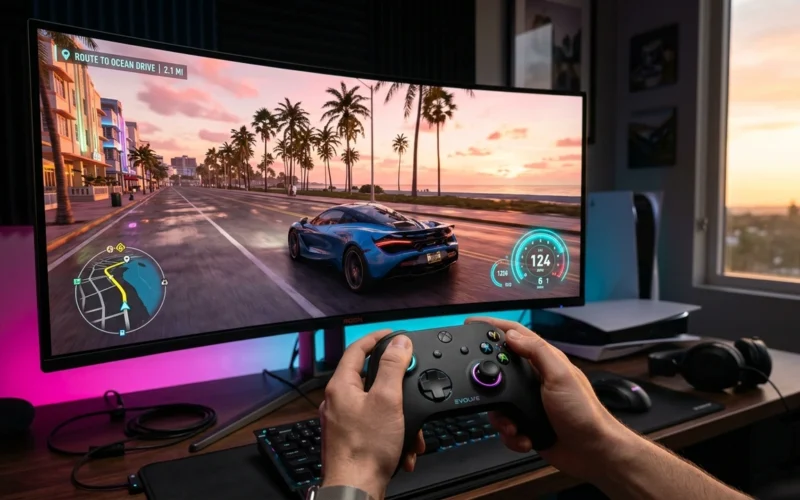
Behind every photorealistic sunset, bustling sidewalk crowd, and responsive vehicle handling in Grand Theft Auto VI lies a proprietary technological titan: the Rockstar Advanced Game Engine, universally known as RAGE. In its ninth major architectural iteration, RAGE 9 represents one of the most sophisticated pieces of software engineering in the history of interactive digital media. At Cyber Leek, we dive deep beneath the hood to analyze how this cutting-edge game engine redefines physics simulation, lighting pipelines, artificial intelligence, and open-world streaming.
1. The Foundation: What Makes the RAGE Architecture Unique?
In modern game development, many studios rely on commercial off-the-shelf engines such as Unreal Engine 5 or Unity. While these third-party frameworks are undeniably powerful, building a massive, systemic open-world sandbox requires specialized software tools tailored specifically to high-density simulations. For over two decades, Rockstar Games has invested in its own internal technology group to craft and refine the RAGE engine.
What sets RAGE apart is its systemic philosophy. In a RAGE-powered environment, individual systems—weather, physics, artificial intelligence, audio propagation, and lighting—do not function as isolated scripts. Instead, they interact dynamically within a unified simulation framework. A sudden rainstorm doesn’t just change skybox textures; it lowers road friction, causes pedestrians to seek cover, dampens ambient acoustic reverberation, and pools dynamically in topography depressions.
2. The Evolutionary Lineage: From Table Tennis to RAGE 9
To grasp the scale of the technological leap embodied by RAGE 9, it is essential to trace the historical progression of this proprietary framework:
- RAGE 1.0 (Rockstar Games Presents Table Tennis – 2006): Designed as a focused hardware stress test for the Xbox 360 and PS3 generation, pioneering cloth simulation, perspiration physics, and natural kinetic motion.
- RAGE 2.0 & 3.0 (Grand Theft Auto IV & Red Dead Redemption – 2008–2010): Revolutionized 3D urban rendering with integrated Euphoria procedural animation physics, dynamic vehicular suspension, and vast frontier landscapes.
- RAGE 7.0 (Grand Theft Auto V – 2013): Delivered an unprecedented level of environmental diversity across Los Santos and Blaine County on hardware with only 512 MB of system memory.
- RAGE 8.0 (Red Dead Redemption 2 – 2018): Set a photorealistic benchmark for interactive media with volumetric atmospheric lighting, complex wildlife ecosystems, and millimeter-level material degradation.
- RAGE 9 (Grand Theft Auto VI – 2025/2026): Rebuilt specifically for high-speed NVMe solid-state storage, hardware-accelerated ray tracing, multi-threaded processor architectures, and real-time hydrodynamic physics.
3. Groundbreaking Architectural Pillars of RAGE 9
Industry technical disclosures, patent filings, and in-engine visual reveals highlight several transformative pillars introduced in RAGE 9:
A. Real-Time Hydrodynamics and Water Fluid Simulation
Water simulation in previous generations relied heavily on pre-animated vertex shaders and repeating wave displacement maps. In the sub-tropical state of Leonida, where oceans, canals, and wetlands dominate the geography, RAGE 9 introduces real-time hydrodynamic physics.
Water operates as a physical volume characterized by density, viscosity, and buoyancy. Waves propagate organically based on wind velocity, coastal topography, and vessel displacement. When a high-performance boat slices through coastal swells, its hull pushes physical water aside, creating authentic wake displacement that physically rocks nearby watercraft and ripples outward toward sandy shorelines.
B. Hardware-Accelerated Ray Tracing and Global Illumination
Lighting in RAGE 9 transitions fully to physically based rendering (PBR) augmented by hardware ray tracing cores on current-gen consoles. This eliminates the need for static, pre-baked lightmaps. Key lighting capabilities include:
- Dynamic Indirect Bounces: Sunlight piercing through palm trees bounces naturally off sidewalks, subtly illuminating building overhangs with warm ambient color.
- Neon Ray Bounces: At night along Vice City’s Art Deco strip, hundreds of vivid neon tubes cast real-time colored light onto passing vehicle chassis, wet pavement, and pedestrian clothing.
- True Specular Reflections: Mirrors, polished chrome, shop windows, and calm bay waters display accurate geometric reflections without relying on distorted screen-space approximations.
C. Volumetric Meteorology and Atmospheric Density
Weather in RAGE 9 is modeled as a living atmospheric volume. Clouds are three-dimensional volumetric structures that form, shift, and dissipate based on simulated temperature and barometric pressure. Sunlight scatters realistically through coastal humidity, producing authentic crepuscular rays (god rays) and vivid twilight color gradients that mirror South Florida’s unique sky phenomena.
4. Vehicular Physics and Material Deformation
Driving mechanics represent the cornerstone of the franchise, and RAGE 9 completely re-engineers vehicular physics to strike the perfect equilibrium between arcade responsiveness and simulation-grade weight distribution:
- Dynamic Deformation Mesh: Rather than swapping between pre-modeled damaged car parts, RAGE 9 calculates vehicular impacts procedurally. Metal crumples, glass shatters, and bumpers detach based on the exact angle, speed, and point of collision.
- Suspension Kinematics and Weight Transfer: Accelerating, braking, and sharp cornering trigger realistic chassis pitch and roll. Heavy luxury sedans feel appropriately substantial, while lightweight sports cars demonstrate responsive grip and cornering stability.
- Tire Surface Interaction: The physics engine continuously samples surface friction coefficients. Transitioning from dry sun-baked highways to water-logged tarmac or slippery swamp mud demands immediate driver throttle modulation.
5. Behavioral Artificial Intelligence and Patented NPC Frameworks
One of the most profound innovations in RAGE 9 lies in its approach to non-playable characters. Based on patented software architectures assigned to Rockstar’s technical directors, NPCs in GTA 6 move beyond simple looped animation scripts toward systemic behavioral intelligence.
Key AI breakthroughs include:
- Contextual Daily Routines: NPCs maintain persistent daily schedules—commuting to work, stopping for coffee, shopping in boutiques, exercising on boardwalks, and returning home.
- Spatial Awareness and Social Interactions: Groups of pedestrians converse dynamically, react to street spectacles, film viral events on smartphones, and seek shelter under awnings during sudden rainfall.
- Dynamic Escalation Decision Trees: Law enforcement and civilian responses are governed by situational awareness rather than immediate hive-mind aggression. Verbal de-escalation, defensive posture, or retreat are viable systemic reactions.
6. Solid-State Storage and Zero-Latency Asset Streaming
Previous console generations were severely bottlenecked by slow mechanical hard drives (5400 RPM HDDs), which forced developers to duplicate assets and artificially limit vehicle speeds to prevent “pop-in.” RAGE 9 is engineered from the ground up to exploit the ultra-high-speed NVMe SSD architectures of the PlayStation 5 and Xbox Series X|S.
By leveraging direct hardware decompression and direct memory streaming, RAGE 9 streams high-resolution geometry and 4K textures instantaneously into unified system memory. This allows for:
- Massively Increased Travel Speeds: Hypercars, jet aircraft, and speedboats can traverse the continent at realistic velocities without texture popping or geometric LOD popping.
- Seamless Interior Exploration: Players can transition from wide open highways directly into fully furnished, multi-story building interiors with zero loading delays.
- Unmatched Object Density: Every store shelf, street corner, and vehicle interior is packed with microscopic physical props that can be knocked over, manipulated, or examined.
7. 3D Spatial Audio and Acoustic Wave Propagation
Visual fidelity is only half the equation; sound design in RAGE 9 is equally revolutionary. The audio engine calculates physical acoustic wave propagation in real time. Sound waves bounce off concrete high-rises, muffle realistically through double-glazed glass windows, and echo across open ocean causeways.
Whether you are listening to muffled bass leaking from an underground nightclub or tracking the distant, directional hum of a police siren bouncing between skyscraper corridors, spatial acoustics ground the player within a tangible, three-dimensional physical space.
8. Frequently Asked Questions (FAQ) About RAGE 9
What is RAGE in video game development?
RAGE stands for the Rockstar Advanced Game Engine, a proprietary software engine developed by the Rockstar Technology Group to power the physics, rendering, AI, and audio in Rockstar Games titles.
Is RAGE 9 superior to Unreal Engine 5?
While Unreal Engine 5 is a versatile general-purpose engine, RAGE 9 is custom-built specifically for massive, multi-tiered open-world sandboxes with thousands of active AI agents, dynamic physics, and persistent vehicle systems, providing unmatched performance for open-world gaming.
Will GTA 6 support hardware ray tracing on consoles?
Yes. The debut footage and technical analyses confirm that RAGE 9 leverages dedicated hardware ray tracing cores on PlayStation 5 and Xbox Series X for real-time global illumination, specular reflections, and ambient occlusion.
9. Conclusion: A Technological Benchmark for the Next Decade
The RAGE 9 engine is not simply an incremental software patch; it is an architectural masterwork that redefines the outer boundaries of interactive entertainment. By fusing hydrodynamic fluid physics with ray-traced lighting, intelligent NPC behaviors, and instantaneous SSD streaming, Rockstar Games is setting a technological standard that the entire gaming industry will be measured against for the next decade.
Stay connected with Cyber Leek for ongoing technical breakdowns, patent reviews, and architectural deep dives as we continue exploring the future of next-generation gaming software.