
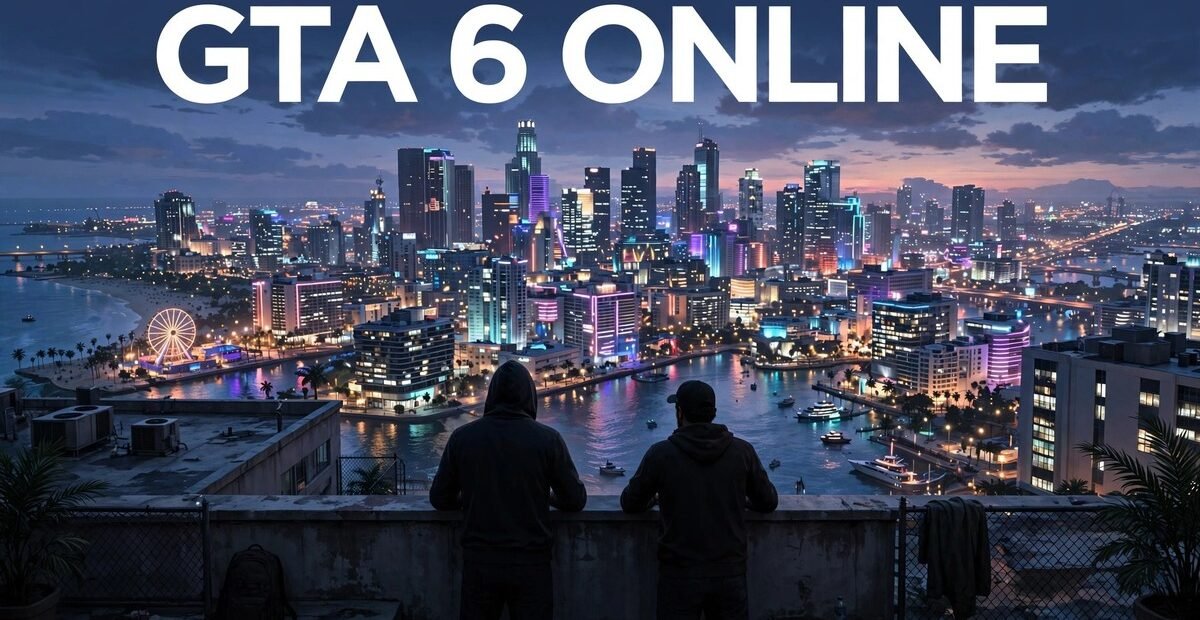

GTA 6 Online: What We Know Before Launch
 By Nadeem
0 Comments
No, Rockstar has not announced GTA 6 Online. The game launching on 19 November 2026 is being sold as a single-player experience, and the only timing we have for any online component comes from reporting, not from Rockstar itself. That distinction matters more than it sounds. Search for GTA 6 Online right now and you will find confident headlines, firm dates, and detailed breakdowns of a mode that does not officially exist yet. This post does the opposite: it separates what Rockstar has actually said from what reporters have heard, and it explains why one widely repeated date — “late 2027” — is not what it first appeared to be.
If you only take one thing from this article, take this: as of 18 November 2026, there is no GTA 6 Online announcement to wait for a trailer for, no name to search for on a store page, and no date on Rockstar’s calendar. There is a single-player launch on 19 November, and there is a report that an online component is expected in 2027. Everything else is still unconfirmed.
The product on the shelf is single-player
GTA VI launches on 19 November 2026 on PS5 and Xbox Series X|S, with no PC version at launch. Rockstar’s pre-order release, dated 24 June 2026, describes the game as “a single-player experience” — deliberate wording, consistent with how the game is listed elsewhere. The PlayStation Store lists “1 player” and notes that offline play is enabled.
Put those three points together and the picture of launch day is clear. You buy GTA VI, you play it on a console, and you play it alone. That is the product Rockstar is selling on 19 November. It is not a placeholder description, and it is not a page that forgot to mention multiplayer. The single-player framing is the framing. That also means the launch conversation is, for now, a story conversation. It is about Lucia and Jason, about Leonida, about the world Rockstar has built for one player to move through.
The one report that actually matters
The most substantial reporting we have comes from Bloomberg’s Jason Schreier. On 14 October 2026, Schreier reported that the online component is “expected to be released in 2027.” Read that sentence again, slowly, because the wording does most of the work. “Expected to be released in 2027” is not a date. It is not a season, not a month, and not a quarter. It is a year, and it is an expectation, reported by a journalist with a long record on Rockstar, rather than a date announced by Rockstar.
That is still useful information. It tells us that people close to the project expect an online component to follow the single-player launch, and that the current expectation points to the year after launch rather than to launch day itself. It does not tell us when in 2027, what the mode will be called, how it will work, or whether that expectation will hold. A year is a wide window, and expectations can move.
What a report can and cannot do
It is also worth being honest about what a report like this can and cannot do. Schreier’s reporting gives us a credible sense of direction. It does not give us a promise. Rockstar has not confirmed the report, has not repeated the 2027 timing, and has not said anything at all in public about an online mode. Until Rockstar does, 2027 remains a reported expectation, and it should always be described that way. “Bloomberg reported” is doing real work here. It tells you who said it, and it tells you who did not.
How “late 2027” got invented
Here is where the story gets messy, and where most of the confusion online comes from. On 13 November, Bloomberg Originals published a video titled “Why GTA 6 Took 13 Years and $1 Billion to Make,” whose narration described the online component as arriving in “late 2027” — about a year after launch, in the shorthand that spread afterwards. That line travelled fast. It was specific enough to sound like news, and it was attached to Bloomberg, a name people trust on this beat. Within a day, “late 2027” was being quoted as if it were the new release window, and in some places as if it were a confirmed date.
It was neither. Schreier later clarified that the “late 2027” line came from the scriptwriter, not from his sources, and that it reflects the general 2027 expectation rather than a dated window. Forbes reported the clarification on 13 November, and Game Rant followed on 14 November. That correction matters, and it is the reason this post exists. The difference between “expected in 2027” and “late 2027” looks small on a screen. In practice, it is the difference between a year-long window and a three-month window, and between a reported expectation and a line written for narration. One is sourced reporting. The other is a scriptwriter’s phrasing of that reporting, and the reporter himself has said so.
The takeaway for readers
So if you see “late 2027” presented as a confirmed window, or as Schreier’s own reporting, that version is wrong. The correct version is simpler and less dramatic: Bloomberg reported an online component expected in 2027, with no narrower window. A video narration then used the phrase “late 2027”, and that phrase was later corrected back to the general 2027 expectation. There is a lesson in that sequence that goes beyond GTA. A precise-sounding date is not the same as a precise piece of information. Sometimes the extra precision comes from a script, a headline, or a paraphrase, rather than from a source. When the reporter whose name is attached to the story steps in to correct it, the correction is the story. For readers, the practical takeaway is straightforward. Do not plan around late 2027. Do not treat it as a date Rockstar has set, or as a window Schreier’s sources gave. Treat 2027 as the reported expectation, leave the rest blank, and wait for Rockstar or for further sourced reporting to narrow it down.
A second signal, from Twitch
There is one more public comment worth including, because it is often quoted alongside the Bloomberg reporting, and because it is easy to over-read. In September, Twitch CEO Dan Clancy told Bloomberg that Twitch expects a bigger jump “next year when they launch multiplayer.” The “next year” in that sentence points to 2027, the year after the 19 November 2026 launch, and the “they” is Rockstar.

What the quote does not say
That is a real quote, from a real executive, to Bloomberg. It lines up, in broad terms, with the 2027 expectation Schreier reported a month later. It is another data point suggesting that people outside Rockstar expect a multiplayer launch in 2027. It is not a Rockstar announcement. Clancy runs Twitch, not Rockstar. He is describing what Twitch expects, and what Twitch is preparing for, not what Rockstar has confirmed. His comment tells us something about how the streaming world is thinking about 2027. It does not tell us a date, a name, or a feature set, and it should not be quoted as if Rockstar had said it.
Used carefully, the comment is still useful. Two separate signals pointing to 2027 — a Bloomberg report in October and a Twitch executive’s expectation in September — are more interesting than one signal on its own. Used carelessly, it becomes another false confirmation. The line between those two uses is attribution. Say who said it, say what they actually said, and do not upgrade an expectation into an announcement.
The list of things nobody knows yet
This is the longest section in spirit, even if it is the shortest to write, because the list of unknowns is long. We do not know whether the online component will have a separate name. We do not know when in 2027 it might arrive, or whether the 2027 expectation will hold. We do not know what it will include, how it will be accessed, whether it will be part of the main game or a separate download, or what it will cost, if anything beyond the base game. We do not know how many players it will support, what activities it will offer, or how it will connect to the single-player story, if it connects at all.
We also do not know what Rockstar’s own timeline looks like. Rockstar has not said when it will talk about online, or whether it will talk about it before launch, at launch, or months afterwards. It has not said whether the online component is already in a state to be shown, or whether it is still early work that will need most of 2027.
Why Rockstar is staying quiet, and why that is not unusual
It is tempting to fill silence with theories. Resist that temptation, at least when it comes to facts. What we can say, without inventing anything, is that Rockstar’s public position is consistent. It is selling a single-player game for 19 November, on PS5 and Xbox Series X|S, with no PC version at launch. Talking about an online mode now would change that conversation. It would turn a launch story into a roadmap story, and it would invite questions Rockstar is not yet answering.
That focus also gives the single-player game room to breathe. Launch week is already going to be loud. There will be reviews, playthroughs, discussion of the story, and, inevitably, discussion of the music and the nightlife of Leonida. None of this proves that an online component will arrive in 2027, or that it will not. It only explains why Rockstar might not be in a hurry to talk about it. The company has a game to launch tomorrow. The online conversation can wait until after that game is in players’ hands.
How to recognise real GTA 6 Online news when it arrives
Real news about GTA 6 Online, when it comes, will be easy to recognise, because it will look different from the speculation filling the gap now. First, it will come from Rockstar, or from sourced reporting that names its basis. A Rockstar announcement will appear on Rockstar’s own channels. Sourced reporting will come from a reporter with a record on this beat, and it will be careful about what is confirmed and what is expected. Both are very different from a screenshot, an anonymous post, or a video thumbnail with a date on it.
Second, it will be specific in a way that speculation is not. A real announcement gives you something to check: a name you can search for, a date you can put in a calendar, a trailer you can watch. Speculation gives you confidence without checkable detail. If a claim cannot be checked against Rockstar or against a named report, it is not yet news. Third, it will be consistent. If Rockstar announces a date, its store pages, its press release, and its social channels will all say the same thing. If Bloomberg reports a window, other reporting will either confirm it, narrow it, or correct it — as Schreier himself did with the “late 2027” line. Watch for that pattern of confirmation and correction. It is how real information behaves. Until then, the honest position is to wait. It is not exciting, and it does not make for an exciting headline. But it is the position that will still be correct in a month, when the confident dates from this week have quietly been forgotten.

GTA 6 Voice Cast: Dylan Rourke as Jason, Manni L. Perez as Lucia, and Every Actor Revealed
Rockstar Games kept the cast of Grand Theft Auto VI a secret for years. Through two trailers, a year of…
Read More →
GTA 6 PS5 vs PS5 Pro vs Xbox: Performance, Frame Rate and Is the Pro Worth $899.99?
GTA 6 is finally out, and the question every console player has been asking for years now has a definitive…
Read More →
How to Make Money Fast in GTA 6: Barn Glitch, Fencing and Legit Methods
Money runs everything in GTA 6. Cars, safehouses, weapons, clothes, businesses, none of it comes cheap, and the game’s economy…
Read More →
GTA 6 Launch Bugs and Crashes: CE-108255-1 Error, Fixes and What Rockstar Has (Not) Said
GTA 6 launched on 19 November 2026 to record-breaking sales, but for a slice of players the biggest open-world game…
Read More →