Anbernic Handheld 3DS Emulator Dispute: RG DDS, Azahar Plus and the Open Source Backlash
 By Nadeem
0 Comments
The rapid evolution of portable emulation hardware has reached a dramatic flashpoint. Over the past five years, specialized manufacturers such as Anbernic, Retroid, and Ayn have transformed what used to be a niche DIY hobby into a thriving global industry. Millions of gamers now carry pocket-sized Linux and Android devices capable of running classic console libraries with crisp upscaling, custom shaders, and long battery life.
Yet, this booming commercial sector has always existed in an uneasy alliance with the volunteer-driven open-source software community. Open-source developers spend countless unpaid hours reverse-engineering legacy microarchitectures and writing sophisticated emulation cores. Hardware vendors, meanwhile, package these software achievements into consumer products, frequently marketing them to retail audiences who may not understand the delicate legal balance keeping emulation alive.
When official promotional demonstrations for the RG DDS showcased 3DS gameplay powered by an unapproved, piracy-oriented software variant dubbed Azahar Plus, the core development team behind mainline Azahar issued a scathing public condemnation. In an unprecedented move, the developers announced an immediate and comprehensive boycott, dropping all official support for Anbernic devices.
1. The Post-Citra Reality: Why 3DS Emulation Walks on Legal Eggshells
To grasp why the Azahar team reacted with such fierce intensity, one must revisit the seismic events of early 2024. For over a decade, Citra stood as the undisputed titan of Nintendo 3DS emulation, enabling high-definition preservation of titles like The Legend of Zelda: Ocarina of Time 3D, Fire Emblem Awakening, and Pokémon Sun and Moon. Citra was developed by Tropic Haze LLC, the same parent organization responsible for the Nintendo Switch emulator Yuzu.
In March 2024, Nintendo of America filed a monumental federal lawsuit against Tropic Haze. While the lawsuit focused primarily on Yuzu and the pre-release distribution of The Legend of Zelda: Tears of the Kingdom, Nintendo’s legal counsel crafted an argument that fundamentally altered the digital preservation sphere.
Rather than relying purely on traditional copyright infringement, Nintendo anchored its case in the anti-circumvention provisions of the Digital Millennium Copyright Act, commonly known as Section 1201. Under this statute, creating or distributing tools designed to bypass technological measures that effectively control access to copyrighted works is illegal, regardless of whether the end user owns legitimate physical media.
To avoid a protracted and financially devastating courtroom battle, Tropic Haze settled with Nintendo for 2.4 million dollars, agreeing to surrender its domain names, cease development, and permanently delete all code repositories for both Yuzu and Citra. In an instant, the gold standard of 3DS emulation was wiped from public distribution.
In the aftermath of Citra’s forced shutdown, community developers scrambled to safeguard years of collective research. From those efforts emerged Azahar, an open-source project created with extreme legal caution.
The Azahar maintainers recognized that to survive in an era of aggressive corporate litigation, their codebase had to remain spotless. Crucially, the mainline Azahar project deliberately omitted automated decryption algorithms and refused to support encrypted game files out of the box. To run games legally on official Azahar releases, users are required to supply their own decrypted ROMs dumped from authentic cartridges using homebrewed hardware. This architectural barrier served as a vital legal firewall, ensuring that Azahar merely emulates hardware behavior without acting as a decryption circumvention tool.
2. Enter Azahar Plus: The Fork That Sparked the Fire
While the official Azahar team pursued legal prudence, a splinter segment of the community grew frustrated with the extra steps required to prepare decrypted game dumps. This friction gave rise to Azahar Plus, an unauthorized third-party fork distributed through separate repositories.
Azahar Plus took the clean-room foundation of mainline Azahar and intentionally re-engineered the exact features that official developers avoided:
- Automated Decryption: It incorporated automated routines to bypass Nintendo 3DS title key encryption, allowing users to run raw, encrypted .3ds and .cia format files downloaded directly from web archives without prior decryption.
- Built-in Cheats and System Asset Grabbers: It introduced automated scripts to fetch system archives, shared fonts, and configuration files directly from unofficial cloud servers rather than requiring clean dumps from physical hardware.
- Unregulated Experimental Patches: It layered speculative speed hacks and visual workarounds on top of the base engine without standard code review or upstream coordination.
For casual users seeking quick plug-and-play convenience, Azahar Plus appeared appealing. But to the architects of the open-source emulation scene, the fork represented an existential hazard. By bundling mechanisms that circumvent cryptographic protection, Azahar Plus wandered straight into the crosshairs of DMCA Section 1201, the precise legal vulnerability that Nintendo used to dismantle Citra.
3. The Promotional Trigger: Anbernic and the RG DDS Showcase
The situation escalated from a quiet developer grievance into an industry-wide firestorm when Anbernic published promotional video teasers for its most anticipated product of the year: the Anbernic RG DDS.
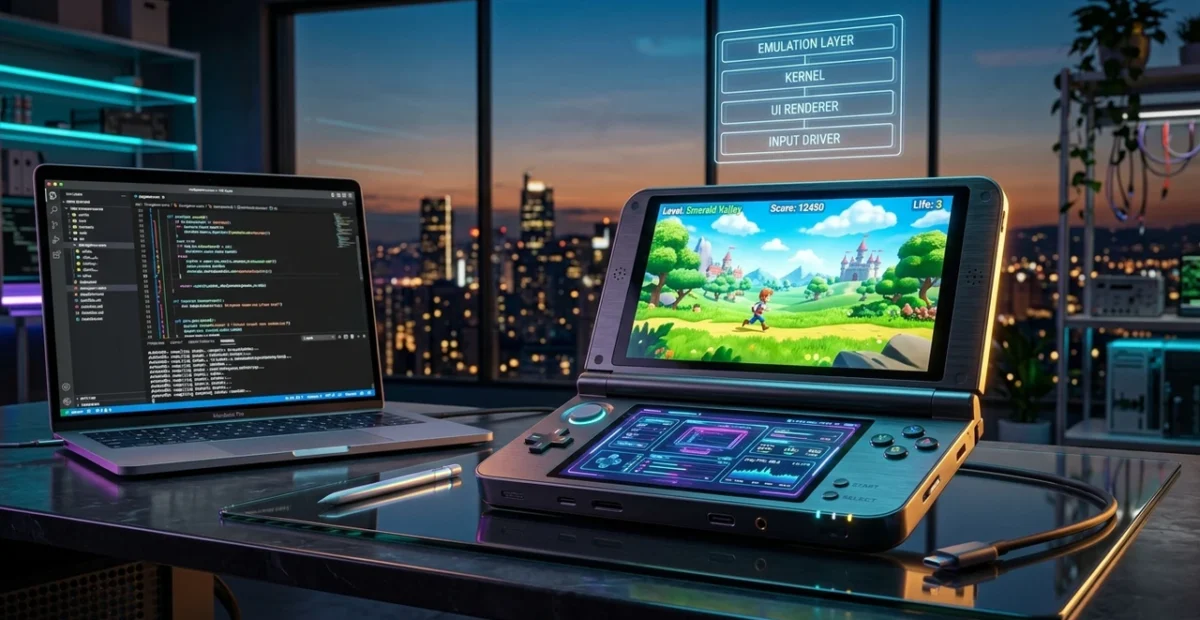
The RG DDS represents a major conceptual milestone for retro enthusiasts. Modeled with a clamshell foldable form factor featuring two distinct screens, the device is explicitly engineered to replicate the tactile experience of the Nintendo DS and 3DS. Powered by a high-efficiency Qualcomm Snapdragon processor, the handheld promises to eliminate the awkward split-screen compromises that have plagued single-screen gaming devices for years.
However, keen-eyed viewers and developers quickly spotted something troubling in Anbernic’s promotional b-roll and hardware demonstrations. Rather than showcasing the device running the official, legally compliant build of Azahar, Anbernic’s marketing footage prominently featured the interface and branding of Azahar Plus.
The implications were immediate and severe:
First, a commercial hardware manufacturer was actively utilizing a piracy-focused fork to market a retail product for profit.
Second, Anbernic appeared to be validating the circumventing software as the recommended method for enjoying 3DS games on the RG DDS.
Third, and most concerning to open-source developers, the promotional campaign blurred the distinction between the legitimate Azahar preservation project and an unauthorized fork, effectively dragging the official development team into legal jeopardy.
4. The Backlash: Azahar Cuts Ties and Drops Official Anbernic Support
The leadership of the Azahar emulator project responded swiftly and decisively. Issuing a public statement across community forums and development channels, the maintainers explicitly denounced Anbernic’s conduct and announced immediate retaliatory policies.
The core development team laid out their grievances in stark terms:
- Rejection of Piracy-Focused Software: The developers publicly labeled Azahar Plus an unofficial, piracy-oriented fork that compromises the integrity and legal security of the broader emulation community.
- Exploitation Without Contribution: They criticized the commercial practice of taking unpaid volunteer code, altering it to circumvent copyright safeguards, and using it to drive hardware sales without returning improvements or acknowledging licensing conditions.
- Total Withdrawal of Device Support: In response to Anbernic’s marketing strategy, the Azahar team announced that they will no longer provide official support for Anbernic hardware.
Under this new policy, the consequences for Anbernic users and hardware are tangible:
- Bug Reports Summarily Closed: Any issue, crash report, or graphical glitch submitted to the official Azahar issue tracker that originates from an Anbernic device will be closed without investigation.
- No Targeted Hardware Optimization: The official Azahar development roadmap will exclude performance tuning, thermal profiling, or driver workarounds specifically tailored to Anbernic’s custom motherboards and display configurations.
- Clear Reputational Separation: By cutting off official relations, the Azahar team constructed an unambiguous public record demonstrating that the legitimate software project maintains zero formal ties to Anbernic’s commercial operations.
5. The Commercial Grey Area of Retro Handheld Manufacturing
This dispute did not occur in a vacuum. It is the culmination of years of friction between Chinese hardware manufacturers and the global software community.
Companies like Anbernic, Powkiddy, and Miyoo have built profitable international businesses by selling high-value hardware at competitive prices. However, their relationship with intellectual property has long operated in a legal twilight zone:

The Preloaded SD Card Dilemma
For years, many handheld brands packaged their devices with micro-SD cards containing thousands of copyrighted game ROMs spanning consoles from the Atari 2600 to the PlayStation 1 and Nintendo 64. While this bundled convenience helped drive massive retail sales through online marketplaces like AliExpress, Amazon, and eBay, it also attracted mounting scrutiny from international copyright coalitions.
Recently, trade organizations such as the Entertainment Software Association, which represents major publishers including Nintendo, Sony, and Microsoft, submitted formal petitions to the United States Trade Representative. These petitions specifically highlighted overseas hardware manufacturers that export devices bundled with unauthorized game libraries, urging tighter border enforcement and intellectual property crackdowns.
Open Source and GPL Compliance Friction
Beyond copyright issues with game publishers, handheld makers have frequently clashed with open-source emulator authors over General Public License compliance. The GPL mandates that anyone distributing modified versions of open-source software must make the underlying source code freely available to the public.
Historically, several hardware companies have bundled modified Linux kernels, custom RetroArch cores, and standalone emulators inside their proprietary device images while refusing to publish their source repositories or acknowledge the original authors. This one-way extraction of community labor has fostered deep resentment among volunteer programmers who watch commercial brands monetize their work while leaving them to absorb user complaints and corporate legal threats.
6. Technical Analysis: The Anbernic RG DDS Hardware Profile
Despite the software storm swirling around it, the Anbernic RG DDS remains one of the most intriguing pieces of dedicated emulation engineering revealed in recent years. Dual-screen devices have long been considered the holy grail of portable retro hardware due to the unique ergonomic demands of the Nintendo DS and 3DS libraries.
| Feature Specification | Anbernic RG DDS Engineering Details | Significance for Dual-Screen Gaming |
|---|---|---|
| Form Factor | Clamshell Foldable Dual-Display | Replicates authentic Nintendo DS and 3DS geometry without vertical split-screen bars |
| Primary Top Display | High-Definition Widescreen Panel | Provides ample real estate for 3D game rendering and widescreen widescreen hacks |
| Secondary Bottom Display | Integrated Capacitive Touchscreen | Enables authentic stylus and touch input for menus, mini-games, and secondary screens |
| Internal Processor | Qualcomm Snapdragon Mobile Platform | Delivers modern CPU architecture and Adreno GPU drivers suitable for demanding 3D shaders |
| Operating System | Custom Android Distribution | Offers broad application compatibility and native touch support across modern emulators |
| Cooling Solution | Active Fan and Copper Heatsink | Sustains higher clock frequencies during extended emulation workloads without thermal throttling |
While conventional single-screen handhelds force players to choose between awkward side-by-side splits, hybrid picture-in-picture windows, or squished vertical layouts, a dedicated dual-screen form factor provides true hardware parity with the original console design.
However, running two displays simultaneously on Android is notoriously demanding. It requires clean display routing, optimized rendering pipelines, and close cooperation between hardware drivers and emulator software. By alienating the primary development team responsible for 3DS emulation, Anbernic has significantly complicated the software ecosystem for its flagship machine.
7. The Legal Minefield: Why Nintendo’s Shadow Loom Large
The underlying urgency behind the Azahar team’s reaction becomes obvious when viewed through the prism of Nintendo’s aggressive global legal strategy. In recent years, Nintendo has systematically targeted every facet of the emulation and modification ecosystem:
- Criminal Prosecutions and Restitution: The high-profile prosecution of Gary Bowser and Team Xecuter demonstrated that Nintendo is willing to pursue criminal penalties and permanent wage garnishment against commercial entities profiting from circumvention hardware.
- The Tropic Haze Settlement: The takedown of Yuzu and Citra established that even non-profit open-source projects can be brought down if their distribution or documentation can be linked to circumvention or piracy facilitation.
- Third-Party Emulator Pressure: Following Yuzu’s demise, the Nintendo Switch emulator Ryujinx ceased public distribution following direct contact between Nintendo and its lead developer.
- Patent Infringement Claims: Nintendo’s recent patent lawsuit against Pocketpair, the developers of Palworld, further underscores the company’s willingness to deploy novel legal theories to protect its intellectual property moats.
For software creators like the Azahar team, survival depends entirely on maintaining an unassailable legal posture. They cannot afford to let their software be linked to piracy in marketing materials viewed by millions of prospective buyers. When a hardware company displays an unauthorized fork that bypasses encryption, it hands corporate litigators the exact evidence needed to claim that the emulation tool serves primarily as an instrument of copyright infringement.
8. What This Means for Retro Gamers and Handheld Buyers
For consumers interested in the Anbernic RG DDS and dual-screen gaming, the dispute creates several practical challenges and trade-offs:
The Out-of-the-Box Experience
Buyers should anticipate that Anbernic will either ship the RG DDS with an unofficial fork pre-installed or leave the device devoid of 3DS emulation software entirely, forcing users to configure their own emulators manually.
Future Compatibility and Bug Fixes
Because the mainline Azahar team will not address bug reports from Anbernic hardware, users who encounter visual glitches, audio stuttering, or game-specific crashes on the RG DDS cannot rely on upstream updates to resolve them. Instead, community members or independent software modders will have to develop third-party workarounds.
Alternative Software Options
While Azahar represents the current leading edge of post-Citra 3DS development, it is not the only option available:
- Lime3DS: Another prominent, community-led Citra fork focused on broad desktop and mobile stability.
- Mandarine: An open-source 3DS emulator optimized for performance improvements across select Android chipsets.
- Original Hardware: For enthusiasts prioritizing 100 percent game compatibility and authentic stereoscopic 3D, modded New Nintendo 3DS XL hardware remains a competitive alternative.
9. Frequently Asked Questions (FAQs)
Can you still install and run official Azahar on Anbernic devices?
Yes. Azahar is open-source software, and users can manually download the official APK or Linux build and run it on compatible Anbernic hardware. However, the development team will not investigate bug reports, offer device-specific performance profiles, or provide troubleshooting assistance for Anbernic products.
What is the primary difference between Azahar and Azahar Plus?
Official Azahar focuses on clean, legally compliant hardware emulation that requires users to supply their own decrypted game files. Azahar Plus is an unauthorized third-party fork that includes automated decryption tools, integrated cheat menus, and automated asset downloads that bypass Nintendo encryption standards.
Why did Anbernic use Azahar Plus in their promotional videos?
Anbernic likely used Azahar Plus because it simplified their testing and recording workflow by running encrypted game files directly without needing prior manual decryption. However, showcasing this software publicly sparked severe backlash from the open-source community due to the legal risks it creates.
Will the Anbernic RG DDS still be able to play 3DS games?
Yes. Thanks to its Qualcomm Snapdragon processor and dual screens, the RG DDS possesses capable hardware for 3DS emulation. However, software optimization, display management, and game compatibility will rely heavily on community-developed setups rather than direct support from official emulator maintainers.
10. Conclusion: Preserving the Balance of Open-Source Emulation
The dispute between Anbernic and the Azahar development team illustrates the fragile reality of the retro gaming industry. Commercial hardware manufacturers have created remarkable devices that allow classic games to be enjoyed on modern, high-definition displays. Yet, those devices are only as good as the software that powers them.
Open-source developers are not free research-and-development contractors for commercial hardware brands. They are preservationists, enthusiasts, and volunteers who operate under the constant threat of corporate litigation. For the retro handheld market to mature sustainably, manufacturers must learn to respect software licensing, support upstream projects, and maintain rigorous boundaries against piracy-oriented circumvention tools.
As the Anbernic RG DDS approaches its full commercial debut, this dispute stands as a necessary reminder: in the world of video game preservation, software integrity and legal responsibility must always come first.