

Tifa Lockhart Counterfeit Figures: 13 Arrested in $300,000 Fake FF7 Merch Bust
 By Nadeem
0 Comments
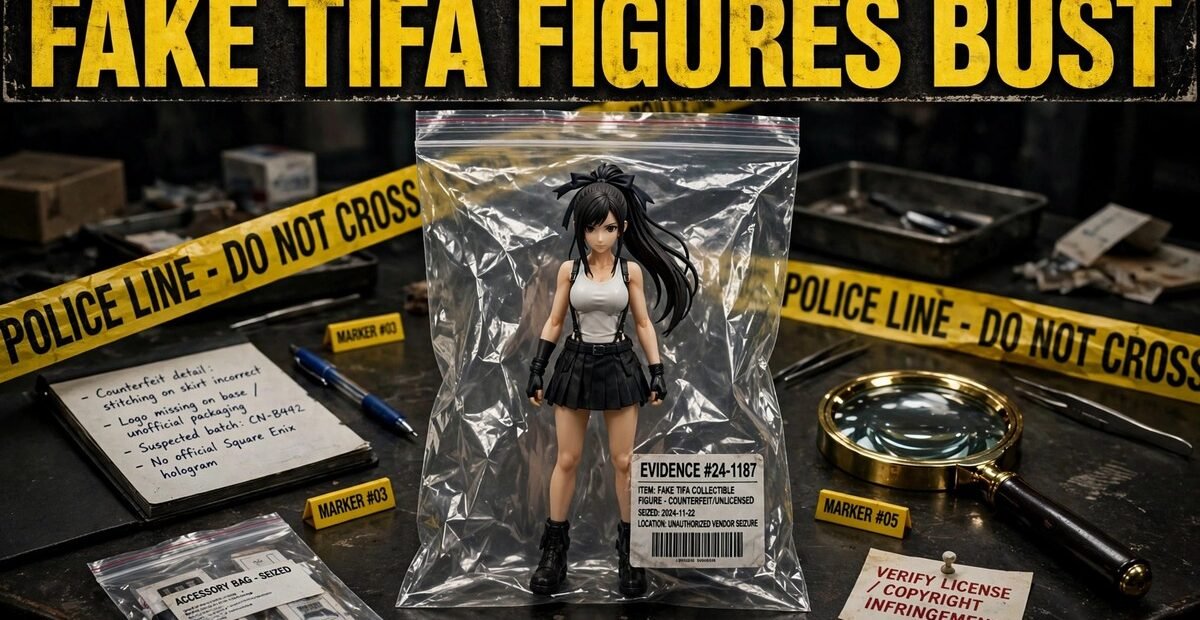
Shanghai police have arrested 13 people accused of running a counterfeit Final Fantasy VII figure operation built around Tifa Lockhart, one of the most popular characters in gaming. The group is accused of selling bootleg figures that generated more than 2 million yuan in sales, roughly $300,000, and police have shut down two storefronts and seized large quantities of fake figures and model kits. It is one of the biggest counterfeit collectible cases of the year, and it carries a twist that has surprised even seasoned collectors: the fake figures were not cheap knockoffs. In many cases, they cost more than the genuine product, and buyers were paying a premium for figures that had never been authorised by Square Enix. Many of them apparently had no idea.
That detail changes the shape of the story. This is not a case about bargain hunters knowingly buying a cheap copy. It is a case about an operation that ran like a real retail business, sold a premium product at a premium price, and kept going for roughly two years before buyers themselves brought it down.
How the case came to light
According to reports, Shanghai police arrested 13 people in connection with the sale of counterfeit Final Fantasy VII figures of Tifa Lockhart. The operation is said to have generated just over 2 million yuan in sales, which converts to roughly $300,000. Police also closed two storefronts linked to the group and seized large quantities of bootleg figures and model kits. Some outlets describe the roughly $300,000 as the value of goods seized rather than total sales. The underlying number is the same, more than 2 million yuan, so this article reports it as more than 2 million yuan, about $300,000, in sales, with large quantities of figures seized.
The investigation began in May 2026, after buyers complained that figures they had purchased did not match official products. The materials felt different, according to those complaints, and the quality did not line up with what buyers expected from a licensed figure. Police then confirmed with the rights holder, Square Enix, that the sellers had no authorisation to produce or sell the figures. That confirmation is the key legal point in the case. The figures were not simply unlicensed lookalikes sold in a grey area. Police say the sellers had no permission from the rights holder at all, which makes the products infringing reproductions rather than unofficial fan merchandise.
The leader, known only as Qian
The group’s leader is identified in reporting only by the surname Qian. A customer-service representative was also part of the operation’s front, according to Kotaku and Dexerto, suggesting the group ran its sales like a real retail business, with staff handling buyers’ questions. All 13 suspects are under investigation for selling infringing reproductions, according to Automaton. Square Enix cooperated as the rights holder but did not make the arrests itself; Shanghai police made the arrests.
Two years of production before the arrests
The operation was not a one-off listing or a small batch of fakes. According to Dexerto, Automaton and GameSpark, the group had been having pirated figures made at a factory in Guangzhou since 2024, giving the scheme roughly two years to build up sales before police moved in. That timeline helps explain the scale of the case. Two years of production and sales, spread across storefronts and presumably online channels, gave the group time to reach a large number of buyers. It also gave the counterfeit figures time to circulate through the second-hand market, where they can be much harder to spot, because a figure that has changed hands twice no longer carries the context of the shop that first sold it.
Police have not publicly named every sales channel the group used, and it is not yet clear how many buyers were affected. That uncertainty is part of why the case matters beyond the arrests themselves. The figures are already out there, in collections and in resale listings, and the people who own them may not know what they have.
The strange part: the fakes cost more than the real thing
The most surprising detail in this case is the pricing. The counterfeit figures were sold in three sets priced at 1,280, 1,580 and 2,580 yuan, according to Dexerto, GameSpark, Kotaku and TheGamer. The genuine product, by comparison, costs around 1,000 yuan, roughly $150. In other words, buyers were paying more for a fake than they would have paid for the real thing. That runs against the usual logic of counterfeiting, where a fake undercuts the official price to attract bargain hunters. Here, the higher price was part of the appeal.
The reason, according to the reporting, is that the bootleg figures came with extra faces, hands and accessories, along with what has been described as “extreme modifications” to the figure. Collectors who wanted more display options, or a version of the figure that looked different from the standard release, were willing to pay extra for those additions, even though the product was unauthorised. This is a pattern that shows up repeatedly in the collectibles market. A licensed figure is released in a fixed configuration, and demand builds for variants, extra parts or alternate poses that the official release does not offer. Counterfeiters step in to fill that demand, and because their product offers something the official one does not, they can charge a premium for it.
Why the high price should worry collectors
The risk for buyers is obvious, and it is the part of this story that should worry collectors most. A figure that costs more than the genuine article can feel more legitimate, not less. Price is often used as a shortcut for authenticity, on the assumption that a fake would be cheap. Here, that shortcut would have pointed buyers in exactly the wrong direction. A higher price does not make a counterfeit legitimate. The question that matters is authorisation, and police say the sellers had none.
It started with buyers, not police
The investigation began with buyers, not with police or Square Enix, and that detail is worth pausing on. In May 2026, buyers complained that the figures’ materials differed from official products, and those complaints reached the authorities. The people who first raised the alarm were customers who had already paid for the figures. They noticed something felt wrong, the materials, the finish, the quality, and they spoke up. Without those complaints, the operation might have run even longer.

The lesson is practical rather than abstract. Compare any second-hand listing carefully against the official product page: price, included parts, packaging and seller history. And if the materials feel wrong when the figure arrives, do not ignore it. The buyers in Shanghai did not, and their complaints started the investigation. That is also why the advice at the end of this story matters more than it usually does in a news report. The first line of defence in this market is not enforcement. It is the buyer noticing something off and saying so.
One case inside a much larger crackdown
The Tifa bust is not an isolated case. It sits inside a much larger crackdown on intellectual-property violations involving collectible figures in Shanghai this year. According to Dexerto, Shanghai police have investigated more than 30 IP-violation cases involving collectible figures in 2026, involving more than 140 suspects and a total case value of more than 70 million yuan. Kotaku, citing GamesRadar, reports that more than 140 individuals have been arrested and more than $10 million in bootleg toys confiscated in Shanghai this year alone.
Those numbers put the Tifa case in context. A single operation worth roughly $300,000 is significant on its own, but it is one piece of a much bigger enforcement effort. The collectibles market has grown fast, and with it has grown the market for fakes, from figures and model kits to plush toys and trading cards. Enforcement is active, but fakes are a regular feature of the market, not a rarity.
Why Tifa, and why Final Fantasy VII
Tifa Lockhart is one of the most recognisable characters in Final Fantasy VII, and demand for figures of her has been strong for years. That popularity is part of why she became the focus of a counterfeit operation: a well-known character with a large fan base is a safer bet for a counterfeiter than an obscure one. A Tifa figure is a mainstream item with a large audience, exactly what makes it attractive to counterfeiters.
What is reported for 2027
Beyond the bust itself, there is fresh Final Fantasy VII news for fans, although one key detail should be treated as reported, not confirmed. According to Noisy Pixel, Final Fantasy VII Revelation, the third and final game in the remake trilogy, is reported to launch on 8 April 2027 for PlayStation 5, Nintendo Switch 2, Xbox Series X|S and PC, with the PC version coming to Steam, Epic Games Store and Xbox on PC. The same report says Tifa debuts a new look in the game. This comes from a single source, so it should be treated as reported rather than certain until Square Enix confirms it officially.
There is also book news for fans of the series. Noisy Pixel reports that the novel Traces of Two Pasts is getting a paperback edition priced at $18.99, due on 16 March 2027, and that a sequel novel, Rebirth: Dear Destiny, is coming as a hardcover priced at $26.99. As with the game date, these details come from a single report and have not been independently confirmed by Square Enix in the sources reviewed for this article. They are worth knowing about, and worth waiting for official confirmation on, rather than treating as settled.
Checking your own shelf
If you already own a Tifa figure bought from an unfamiliar seller, there is no need to panic, but it is worth checking. Compare your figure against the official product listing: the price, the included parts, the packaging, the materials and the overall finish. If you bought a set that included extra faces, hands or accessories not part of the official release, and you paid 1,280 yuan or more, your figure may match the profile of the counterfeits described in this case. That does not prove it is fake on its own, but it is the pattern the reporting describes, and it is worth taking seriously.
If you are shopping now, buy from authorised retailers or the official Square Enix store when you can. Be wary of sellers offering extra parts or modified versions the official product does not have, check the price against the official release, and read seller reviews before buying from a storefront with little history. The same advice applies well beyond Final Fantasy VII. Counterfeiters follow demand wherever it goes, and when demand is high and supply is limited, someone will try to sell you something that is not what it claims to be. The Shanghai arrests show enforcement can catch up with those sellers. But the first line of defence is still the buyer.


Like a Dragon: Pirate Yakuza in Hawaii Joins PS Plus: Majima, Pirates, and Why It Is Worth Downloading
Goro Majima wakes up on a beach with no memory, no crew and no idea who he is. By the…
Read More →
Black Friday 2026 Gaming Deals: The Best PS5 and Xbox Prices, and Why No Console Is on Sale
Black Friday 2026 falls tomorrow, Friday 27 November, and the gaming sales are already running. Amazon’s Black Friday week sale…
Read More →
PS Plus December 2026 Games: Tony Hawk’s Pro Skater 3+4, Dragon Ball Xenoverse 2 and Amnesia: The Bunker
Sony has revealed the final PlayStation Plus monthly games of 2026, and December closes the year with a lineup that…
Read More →
Gothic 3 Classic Is Out Now on PS5 and Xbox: Price, Platforms, and What the Console Version Changes
Twenty years after it first arrived on PC in a rough, unfinished state, Gothic 3 is finally playable on a…
Read More →