
Phantom Blade Zero Gameplay Deep Dive: Combat Mechanics, Weapon Arsenal, Kungfupunk World and Soulslike Reality
 By Nadeem
0 Comments
However, extensive public hands-on demonstrations across major international events like Summer Game Fest, Gamescom, Tokyo Game Show, and ChinaJoy have shattered those doubts. Phantom Blade Zero is not only genuine; it is shaping up to be one of the most thrilling, mechanically sophisticated character action games of the current console generation.
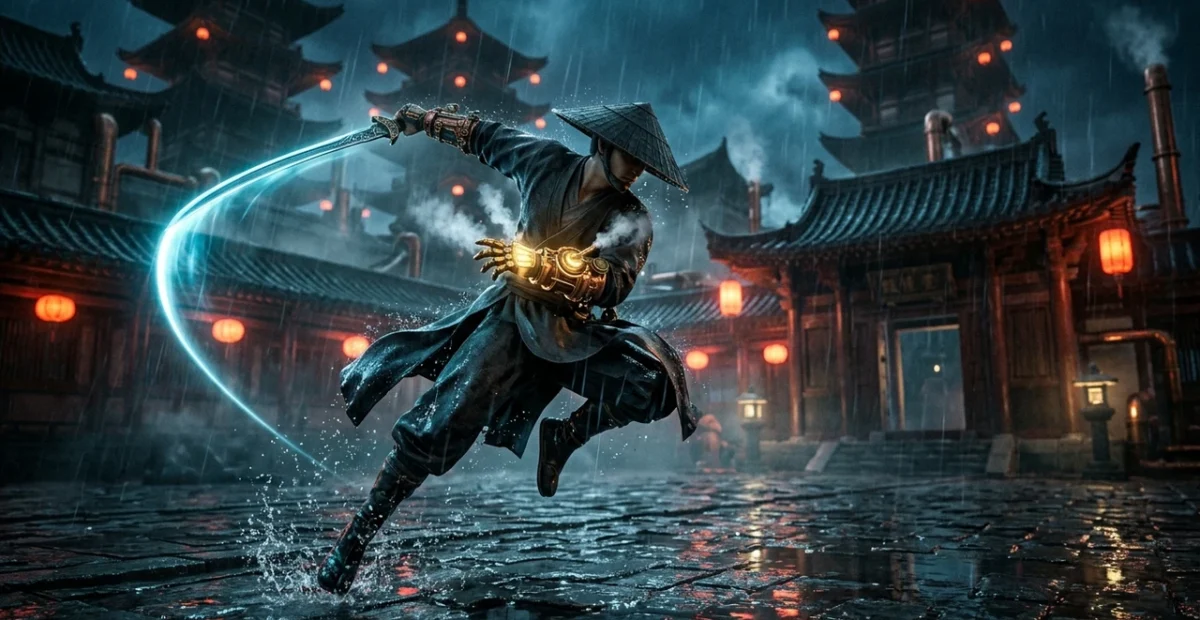
Built natively on Unreal Engine 5 for PlayStation 5 and PC, Phantom Blade Zero introduces players to a uniquely stylized dark fantasy universe known as Kungfupunk. It blends the poetic aerial swordplay and moral chivalry of traditional Chinese Wuxia literature with grim industrial steampunk machinery, occult sorcery, and unsettling body modifications.
1. The Soulslike Debate: Why Phantom Blade Zero Forges Its Own Identity
In recent years, the explosive popularity of FromSoftware blockbusters like Elden Ring and Sekiro: Shadows Die Twice has led players and critics to label almost every challenging dark fantasy action title as a Soulslike. When early trailers revealed meditation shrines serving as checkpoints and imposing, multi-phase bosses, observers immediately assumed Phantom Blade Zero was another punishing stamina-management simulator.
Developer S-Game has repeatedly and emphatically refuted this characterization. While the game respects the high-stakes tension of challenging boss duels, its core mechanical DNA is firmly rooted in the high-octane character action genre.
Offense Over Turtling
In a traditional Soulslike, holding a shield or retreating behind safe perimeter lines is often the safest path to victory. In Phantom Blade Zero, passive turtling guarantees swift defeat. Holding your guard simply delays an inevitable guard break.
The game demands continuous offensive initiative. Your goal is to stay glued to your opponent, chaining light and heavy sword strikes, reading incoming telegraphs, and reacting with split-second counters.
No Stamina Restriction on Basic Attacks
One of the most defining design decisions in Phantom Blade Zero is the complete absence of a stamina bar restricting your offensive actions. You never have to pause mid-combo because your character is out of breath.
Stamina restrictions are reserved purely for defensive dodges, ensuring that evasion requires deliberate timing while offensive expression remains completely unrestricted.
Lineage: From Ninja Gaiden to Metal Gear Rising
Rather than mimicking modern Souls titles, Phantom Blade Zero draws direct inspiration from the golden era of high-speed character action:
- Ninja Gaiden: Blistering combat speed, acrobatic wall interactions, and unforgiving enemy aggression that tests reflexes.
- Devil May Cry: Seamless weapon swapping mid-combo, juggles, and expressive combat freedom.
- Metal Gear Rising: Revengeance: The exhilarating sensory rush of standing your ground and parrying ferocious multi-hit boss strings.
- Sekiro: Rhythmic deflection mechanics that target enemy posture bars rather than simply chipping away at health pools.
2. The Combat Engine: Motion Capture, Stunt Direction and Sha-Chi
The standout marvel of Phantom Blade Zero is how naturally its combat animation flows. In many action games, rapid combos look disjointed, suffering from awkward animation snapping or artificial motion acceleration.
To achieve cinematic authenticity, S-Game enlisted legendary Hong Kong action and stunt director Kenji Tanigaki, renowned for his work alongside Donnie Yen and his martial arts choreography on the live-action Rurouni Kenshin film series.
Every sword strike, dodge roll, foot pivot, and aerial flip was captured from elite martial artists and stunt performers, giving the combat an organic, fluid rhythm reminiscent of classic Hong Kong wire-fu cinema.
The Sha-Chi Resource System
Instead of traditional magic points, Soul’s offensive power is governed by Sha-Chi, which translates to killing intent.
- Generating Sha-Chi: Successfully landing basic attacks, executing clean parries, and evading incoming strikes with Ghost Steps fills the Sha-Chi gauge.
- Expending Sha-Chi: Sha-Chi fuels high-damage martial arts skills, armor-piercing thrusts, and cinematic execution strikes that shred enemy defenses.
Mastering the Defense: Parries and Ghost Steps
Defensive interactions in Phantom Blade Zero are fast, visual, and rhythmic:
- Standard Guard: Absorbs minor basic attacks at the cost of guard meter, but quickly breaks under heavy pressure.
- Deflection / Parry (Yellow Flash): When an enemy winds up an attack telegraphed by a subtle yellow flash, tapping the guard button at the exact moment of impact triggers a precision parry. This deflects the strike, leaves the attacker momentarily staggered, and delivers massive damage to their posture.
- Ghost Step Evasion (Red Flash): Certain lethal boss strikes are telegraphed by an ominous crimson flash, indicating an unlockable, armor-crushing blow. Attempting to parry a red attack leads to devastating damage. Players must execute a Ghost Step, a rapid directional dash that leaves behind a phantom afterimage, allowing Soul to slip behind the adversary and punish their extended recovery window.
3. The Weapon Arsenal: Dual Stances and Secondary Phantom Edges
Versatility is central to surviving in Phantom Blade Zero. Soul can equip multiple primary bladed weapons alongside specialized secondary tools known as Phantom Edges, switching between them instantaneously without breaking combo momentum.
| Weapon Category | Weapon Type & Archetype | Combat Profile & Strategic Utility |
|---|---|---|
| Primary Weapon | Dual Swords | Extremely high attack velocity, rapid Sha-Chi generation, ideal for agile humanoids |
| Primary Weapon | Balanced Longsword | Classic Wuxia blade, superior parry window, exceptional thrust range and directional versatility |
| Primary Weapon | Heavy Broadsword / Saw | Slower swing cadence, massive poise damage, shatters heavy shields and brute armor |
| Phantom Edge | Steampunk Hand Cannon | Explosive mid-range projectile that blasts charging enemies backward and extends juggle combos |
| Phantom Edge | Hidden Repeating Bow | High-precision ranged tool for sniping sentries, detonating explosive barrels, and aerial interrupts |
| Phantom Edge | Mechanical Grappling Chain | Pulls lightweight enemies into melee range or propels Soul directly toward distant targets |
Seamless Combo Weaving
What elevates the weapon mechanics beyond standard action games is the total absence of animation locks during weapon swaps. You can initiate a flurry of lightning-fast slashes with your Dual Swords, instantly swap to a Heavy Broadsword mid-swing to crush an enemy’s raised shield, fire a blast from your Steampunk Hand Cannon to interrupt a counter-attack, and finish with a devastating Longsword thrust, all within a single four-second engagement.
The Player-Friendly Respect System
In many adjacent action RPGs, investing scarce upgrade materials into a weapon you later dislike can permanently ruin a character build.
S-Game deliberately eliminated this player frustration by implementing a complete, penalty-free upgrade refund system. Players can freely dismantle upgraded weapons and reallocate every single enhancement material into an entirely different weapon archetype at any meditation checkpoint. This design choice actively encourages players to experiment with diverse weapons to match specific boss mechanics without fear of wasting hard-earned resources.
4. Boss Encounters: Cinematic Duels and Posture Breakdown
Boss encounters in Phantom Blade Zero are designed as high-drama martial arts duels rather than tests of endurance against spongy health bars. Every boss possesses unique behavioral patterns, environmental interactions, and visual cues.
Notable Demo Boss Encounters
Tie Zhen: The Iron-Armor Brute
One of the most prominent bosses featured in public demos, Tie Zhen serves as a masterclass in rhythm management. Wielding a gigantic cleaver and encased in heavy iron plating, his sweeping swings cover massive arcs.
Attempting to trade hits with him results in swift death. Instead, players must parry his multi-hit vertical chops, Ghost Step through his ground-shattering red attacks, and use the Steampunk Hand Cannon to stagger him when he attempts to charge.
Commander Huang: The Spear Virtuoso
Commander Huang tests the player’s ability to handle rapid thrusts and deceptive reach. Fighting with an extended bladed spear and acrobatic martial arts kicks, Huang utilizes spinning flourishes that create false parry timings.
Defeating him requires reading his subtle wind-ups, deflecting the final strike of his extended spear combos, and capitalizing on the brief recovery windows where his back is exposed.

Seven Sisters: Agile Dual-Blade Assassins
Contrasting with heavily armored brutes, encounters like the Seven Sisters pit Soul against lightning-fast female assassins who employ stealth, smoke bombs, and coordinated pincer strikes.
These duels emphasize spatial awareness, rapid target switching, and utilizing wide sweeping broadsword arcs to catch nimble targets attempting to flank from blind spots.
5. World Design: The Metroid Vania Kungfupunk Architecture
Rather than chasing the industry trend of massive, empty open worlds populated by repetitive filler tasks, S-Game chose a focused, tightly constructed semi-open world structure deeply rooted in Metroid Vania principles.
Interconnected Verticality
The game world is structured around dense, interconnected regions featuring multi-tiered verticality. Players navigate through rain-drenched bamboo forests, crumbling Buddhist temples, underground mechanical foundries, and fortified cliffside strongholds.
Soul possesses remarkable mobility outside of combat, capable of sprinting across vertical walls, vaulting over rooftop tiles, and using his grapple tool to ascend to elevated watchtowers.
Shortcuts, Secrets and Progression
Exploration is richly rewarded. As you venture through a region, you frequently discover locked iron gates, lowered drawbridges, and hidden elevator shafts that loop back to earlier meditation points.
Searching off the beaten path uncovers:
- Ancient Martial Arts Tomes: Granting permanent upgrades to Soul’s core combat move sets.
- Rare Weapon Blueprints: Allowing the forging of exotic weaponry with distinct elemental or kinetic traits.
- Narrative Relics: Unveiling the dark occult lore behind The Order, the bio-mechanical afflictions spreading across the land, and the mystery surrounding the patriarch’s assassination.
6. The Hardcore Endgame: The 66 Days Survival Challenge
The narrative hook of Soul possessing only sixty-six days left to live is not merely a cinematic plot device; it directly shapes the game’s ultimate endgame challenge.
Upon completing the main storyline campaign, players unlock the specialized 66 Days Mode. This dedicated hardcore mode transforms the narrative deadline into an intense, mechanical survival trial:
- Life-Count Constraints: Players are given a finite allotment of days representing their operational vitality.
- Elevated Adversary Intelligence: Enemies feature revised attack patterns, faster recovery windows, and aggressive group coordination.
- Boss Rush Gauntlets: Facing remixed, high-difficulty variants of the game’s iconic bosses with exclusive cosmetic rewards, elite weapon skins, and prestige achievements.
This endgame mode provides hardcore action veterans with the ultimate proving ground to demonstrate their complete mastery over parry timings, weapon swaps, and resource management.
7. Technical Showcase: Unreal Engine 5 on PlayStation 5 and PC
From a visual and technical standpoint, Phantom Blade Zero serves as a showcase for what Unreal Engine 5 can achieve when married to distinct art direction.
| Technical System | Unreal Engine 5 Implementation | Gameplay & Visual Impact |
|---|---|---|
| Nanite Geometry | Virtualized micro-polygon geometry rendering | Unprecedented environmental detail across carved stone statues, ancient tiles, and armor plates |
| Lumen Global Illumination | Real-time dynamic bounce lighting | Atmospheric lighting from flickering red lanterns, moonlit rain puddles, and muzzle flashes |
| Chaos Physics & Cloth | Real-time fabric and fluid dynamics | Flowing martial arts robes, swaying bamboo, and realistic rain splatters on weapon steel |
| Target Performance | Locked 60 FPS Performance Mode on PS5 | Essential for maintaining millisecond-level responsiveness for precision parries |
| DualSense Haptics | Specialized PS5 controller telemetry | Haptic resistance reflecting weapon weights and dynamic vibrations during sword clashes |
On PC, the game will support advanced ray tracing reflections and modern upscaling technologies including NVIDIA DLSS and AMD FSR, ensuring smooth frame rates across a wide spectrum of modern gaming hardware.
8. Frequently Asked Questions (FAQs)
Is Phantom Blade Zero a Souls like game?
No. S-Game has explicitly confirmed that Phantom Blade Zero is a fast-paced character action RPG. There is no stamina bar restricting your offensive attacks, no loss of currency or experience upon death, and combat emphasizes rapid-fire offensive combos and mobility reminiscent of Ninja Gaiden and Devil May Cry.
What platforms will Phantom Blade Zero launch on?
Phantom Blade Zero is currently confirmed for release on PlayStation 5 and PC (via Steam and Epic Games Store).
How long is the estimated main story campaign?
S-Game has indicated that the main storyline campaign will take approximately thirty to forty hours to complete, with extensive side quests, multi-branching Metroidvania exploration, and endgame challenges extending total playtime well beyond sixty hours.
Can you switch weapons in the middle of a combo?
Yes. The combat system fully supports instantaneous weapon swapping mid-combo without pausing the action or interrupting animation momentum, allowing players to weave primary blades and secondary Phantom Edges into custom combo chains.
Who is responsible for the martial arts choreography?
The real-time motion capture and stunt choreography was directed by acclaimed Hong Kong martial arts director Kenji Tanigaki, celebrated for his work with Donnie Yen and the action sequences of the live-action Rurouni Kenshin movies.
9. Conclusion: The Dawn of a New Character Action Classic
Phantom Blade Zero represents a breath of fresh air in an action gaming landscape that has grown increasingly saturated with methodical, slow-paced Soulslikes.
By embracing the fluid acrobatics of classic Hong Kong martial arts cinema, eliminating stamina barriers to empower relentless offensive creativity, and wrapping the experience in a mesmerizing Kungfupunk aesthetic, S-Game is crafting an experience that honors the golden legacy of character action while pushing the genre boldly forward on Unreal Engine 5.
For gamers who crave the adrenaline rush of clashing blades, reading split-second telegraphs, and executing dazzling martial arts combos under moonlit rainstorms, Phantom Blade Zero is rapidly cementing itself as an essential, can’t-miss masterpiece.
Sharpen your blades, master your Ghost Steps, and prepare to enter the Fog. Soul’s sixty-six days are counting down.